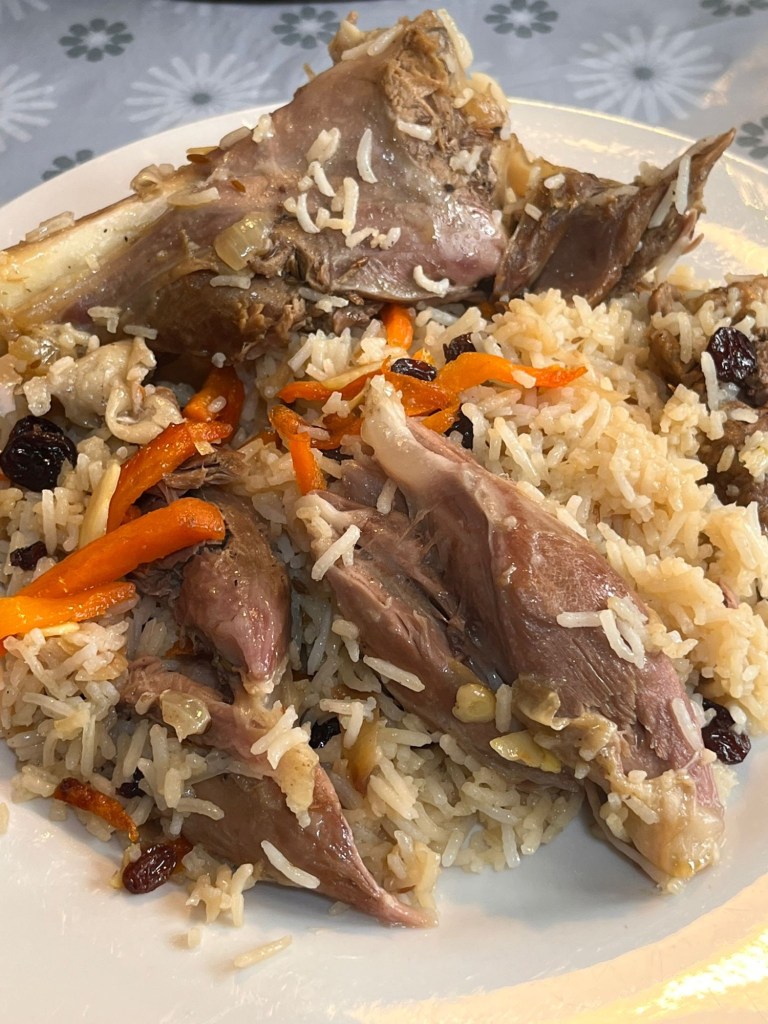
Afghani / Kabuli Pilau
We had Afghan Pilau for the first time a couple of years ago at a local Afghan restaurants. My husband loved it so much we had it on a number of occasions at a restaurant but never attempted to cook it myself. It was only when I researched the recipe that I found it was actually very easy to make. A lot of pots and pans were used in the process but very easy to assemble! When I saw the lamb shanks in our butcher I had to buy it (was £14.50 each and we bought two) and I knew already what I was going to make with it. So, this will definitely a dish that we will only make it a couple of times in the future, unless we get lamb shanks on special!

Kabuli pilau is considered a festive and important dish due to the price (of the meat) and quality of the ingredients as well as its tradition of being Afghanistan’s national cuisine. It’s usually served on special occasions. The dish is traditionally placed in the centre of the table surrounded by other foods. Top tips, don’t let your rice get sticky, it should be fluffy and the grains of rice should be “loose”. This is a very rich and tasty dish, don’t skimp on the oil!
For the meat:
- 2 – 3 large lamb shanks, you can use large lamb or mutton pieces as well
- 8 cloves garlic
- 1 black cardamom pod
- 8 green cardamom pods
- 1 tablespoon coriander seeds
- 1 tablespoon whole black pepper corns
- 1 tablespoon jeera seeds
- 5 cloves
- 3 bay leaves
- 1 large cinnamon stick
- 1 tablespoon salt or to taste
For the carrot topping:
- 4 tablespoon oil for frying
- 2 medium sized carrots, peeled and julienne cut
- 1 large handful raisins or sultanas
- 1 large handful almond slivers
- 1 tablespoon sugar
For the rice:
- 4-5 tablespoon oil
- 3 cloves garlic, finely chopped or grated
- 1 tablespoon cumin seeds
- 2 medium onions, thinly sliced
- 3 cups basmati rice, ideally you want to use a long grain basmati rice.
- Soak the rice in boiling water to cover whilst the meat is cooking.
- 1-2 teaspoons salt, to taste
Method:
- Add all the ingredients for the meat into a large pot and cover with enough water to cover all the meat. Bring to a boil and then cover, simmering for 1.5-2hrs, till the meat is tender but not falling off the bone. Top up with water if needed. Check after 1.5 hours to see if the meat is soft.
- Meanwhile, heat 3-4 tablespoon of oil in a pan, add your julienne-cut carrots. Sauté the carrots on medium heat for 5 minutes, till they are tender, don’t overcook you still want the crunch of the carrots. Add the raisins, stir fry for an additional 5 minutes, till the raisins begin to swell up. Finally, add 1 tablespoon sugar and the almond slivers, stir fry a further minute. Turn off the heat, cover with foil, set aside and keep the carrot mixture warm until needed.
- When the meat is tender, strain out the liquid stock using a colander and discard the whole spices. Reserve the stock.
- In a heavy based pot, heat 4-5 tablespoon of oil, add the cumin seeds, garlic and the onions. Sauté this on medium-high till the onions become lightly brown. You can sauté them more if you prefer a darker shade. How dark or light your onions are will affect the colour of the end result for your rice.
- Once the onions are to your desired colour, add the meat without the stock. Sauté the meat and onions for 10 minutes.
- Add the reserved stock. Bring to a boil.
- In a colander, rinse your rice until the water runs clear. Add the basmati rice and salt onto of the meat. Add more water if necessary, the water should just cover the rice.
- Cook on high heat till the water begins to boil, and then reduces, until there is very little water left in the pot. Stir once or twice using a fork, being careful not to break any rice pieces.
- At this point, reduce the heat to the lowest possible, allow it to steam like this for 10-15 minutes.
- To serve, plate the rice on a large platter topped with the meat. Scatter the raisins, nuts and carrots mixture on top.
- Serve on its own, like we did, or with a garlic yoghurt sauce.




Posted on 29/09/2024, in Afghan Pilau, Rice and tagged Afghan Food, Cape Malay, cape malay cooking, Cape Malay Cooking & Other Delights, Homemade, Salwaa's cape malay cooking, Salwaa’s Cape Malay Kitchen. Bookmark the permalink. Leave a comment.
 Cape Malay Cooking & Other Delights - Salwaa Smith
Leave a comment
Comments 0