Blog Archives

Sago Pudding
Cape Malay Cooking & Other Delights – Salwaa Smith

Perfect dessert for the cold weather! Takes less than 90 minutes to prepare and bake. This recipe can easily be doubled to serve more than 4 – 6 people.
Ingredients:
4 cups milk
1 cup sago
1/2 teaspoon salt
1/2 teaspoon ground nutmeg or 1/2 teaspoon cinnamon
1/2 cup sugar
5 tablespoons butter plus extra for greasing
2 tablespoon custard powder (optional)
1 teaspoon vanilla
4 large eggs
1/2 cup sugar (extra)
Method:
Preheat the oven at 160° Celsius.
Grease a large pudding dish with butter.
Heat milk to nearly boiling, then add sago, salt, and nutmeg or cinnamon.
Simmer over very low heat until sago is transparent.
Mix custard powder with half a cup of water / milk and add to mixture
Add the 1/2 cup sugar, butter and vanilla, and stir in well. Remove from heat.
Separate the eggs, and whisk the yolks. Add yolks to the sago mixture, whisk or mix until combined.
Whisk the egg whites until stiff, and add the extra 1/2 cup sugar slowly, whisking until incorporated.
Gently fold the egg whites into the sago mixture.
Bake in the preheated oven for about 40 – 45 minutes, until set and the pudding is light brown on top.
Serve warm
#capemalaycooking #capemalay

Ramadan Kareem!
Ramadan Kareem from my kitchen to yours
Cape Malay Cooking & Other Delights – keeping our heritage alive
Ramadan – a brief explanation
Ramadan is the 9th month of the Islamic calendar, a religious annual observance and month of fasting that is one of the Five Pillars of Islam. The time spent fasting is meant to be used for prayer, charity, spirituality, and for purifying the mind and body. The beginning and end of the month of Ramadan is determined by the sighting of the new moon. Muslims fast from before sunrise to sunset.

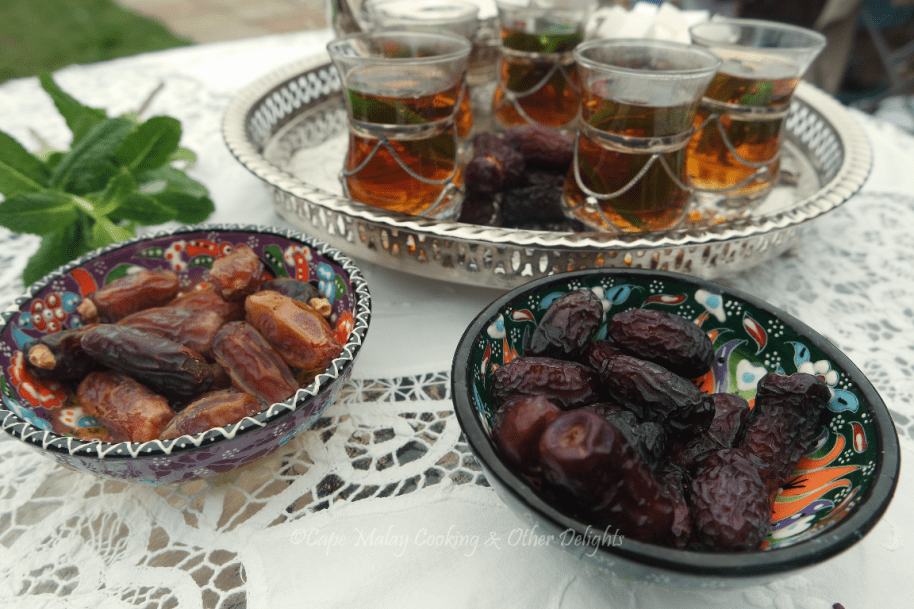
Dates & Mint Tea
Does Ramadan always start on the same day?
No. Because Ramadan is a lunar month, it begins about 10 days earlier each year. During a Muslim’s life, Ramadan will fall during winter months, when the days are short, and summer months, when the days are long.
Why is the month so significant?
Principally because it is the month that Allah revealed the Quran to the last Prophet Muhammad, peace be upon him.
Who is exempt from fasting?
Those who are not required to fast during Ramadan are young children, (those who did not reach puberty) the sick or those with mental illnesses, travellers, the elderly and women who are menstruating, pregnant, breast-feeding or have recently had a baby.
The month of Ramadan contains the most blessed of nights – known as Laylatul Qadr – about which Allah, subhana wa t’ala, says:
‘What will make you realize what the Night of Power is like?
The Night of Power is better than a thousand months.
Angels and the Spirit descend upon it with their Lord´s permission with every command;
There is peace that night until the coming of dawn.
(Quran: 97:1-5)
Traditions
Muslims break their at sunset with dates or water. Traditionally we, the Cape Malays, will have a starter consisting of soup, samosas, dhaltjies, fritters. More often than not after prayers we will have a main meal. During Ramadan plates of food are shared with neighbours. Little children can often be seen carrying plates of food to neighbours, etc… The best charity, the best Zakah, the best Sadaqah is in Ramadan. Feeding the poor and needy fasting people is highly recommended in Ramadan. The Prophet (pbuh) said, ‘Whoever feeds a fasting person, will get a reward like him.’ (Ahmad) He also said, ‘Protect yourself from the fire even by giving half of a date.’ (Agreed upon)

The benefits of Dates
The Prophet (pbuh) used to break his fasts by eating some dates before offering Maghrib prayer. Modern science has proved that dates are part of a healthy diet. They contain sugar, fat and proteins, as well as important vitamins. Dates are also rich in natural fibres. They contain oil, calcium, sulphur, iron, potassium, phosphorous, manganese, copper and magnesium. Dates and palms have been mentioned in the Holy Quran 20 times, thus showing their importance. The prophet likened a good Muslim to the date palm saying, “Among trees, there is a tree like a Muslim. It’s leaves do not fall.”
The Five Pillars of Islam include Sawm: Fasting during Ramadan, Hajj: a pilgrimage to Mecca at least once in their life, Zakat: giving to the poor, Salah: five-time daily prayer, facing Mecca, including absolution prior to prayer, Shahada: declaration of belief in one true God.
May you have a blessed spiritual uplifting month, ameen
Here’s the link to some of my favourite Ramadan treats.

Pineapple Chicken
Pineapple Chicken
Sweet and tangy, flavourful tropical chicken for a quick and easy meal. Prepare beforehand and pop in the oven for a lovely alternative to Sunday roast.

Tropical Pineapple Chicken
Salwaa Smith – Cape Malay Cooking & Other Delights
Ingredients:
1 chicken, skin off and cut into 8 pieces
1 tin canned pineapple rings (440g)
1 Tbsp brown sugar
¼ cup soy sauce
2 Tbsp tomato sauce
3 cloves garlic, minced
1 tsp freshly grated ginger
½ – 1 tsp chilli powder
1 tsp paprika
1 tsp salt or to taste
1 Tbsp cooking oil
Fresh chopped dhanya/coriander/cilantro
#capemalaycooking
Method:
In a medium bowl, whisk together soy sauce, juice of canned pineapple, tomato sauce, garlic, ginger, chilli powder, paprika and salt . Reserve a quarter of the sauce and set aside.
Using a Ziploc bag or large bowl, combine the sauce mixture and chicken. Marinate for at least 1 hour or overnight in the refrigerator, turning the bag occasionally.
Combine the pineapple rings and brown sugar.
Preheat the oven to 220 degrees Celsius.
Transfer the chicken, with the marinade, into an oven proof dish. Cook the chicken, uncovered, for about 45 minutes turning half way through. Pour the remaining reserved sauce and arrange the pineapple rings on top of the chicken. Return to the oven and grill for about 5 – 10 minutes until the pineapple rings are light golden in colour.
Remove from the oven and garnish with freshly chopped dhanya. Serve with a fresh green salad.
Cook’s Tip
Use fresh pineapple and half a cup of pineapple juice instead of the canned pineapple rings.
BBQ (braai) the chicken pieces instead of cooking in the oven.
© Cape Malay Cooking & Other Delights

Orange Bundt Cake
Orange Bundt Cake
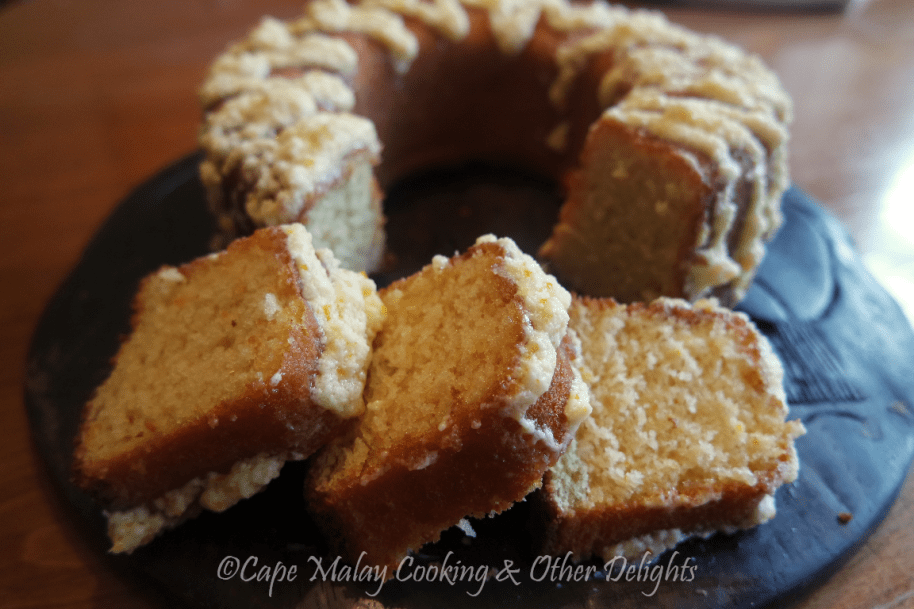
Orange Bundt Cake
Salwaa Smith – Cape Malay Cooking & Other Delights
This cake has a citrusy flavour, the sweet & Sour orange juice and the orange butter icing gives this cake an incredible taste. Absolutely delicious. This cake can also be made in round cake or loaf tins.
Ingredients
2 cups cake flour
3 tsp baking powder
1 cup caster sugar
½ cup milk
½ cup orange juice
½ cup vegetable oil
3 large eggs, beaten
1½ teaspoons grated orange zest
½ tsp orange essence
Orange butter icing:
50g butter, softened
1 cup icing sugar
2 Tbsp orange juice
½ tsp orange essence
1 tsp grated orange zest
Method:
Preheat oven to 180 degrees Celsius. Grease and flour a Bundt tin.
In a measuring jug, combine milk, the orange juice, oil, beaten eggs, essence and
1½ teaspoons orange zest. Set aside.
Sift flour and baking powder into a large bowl. Mix in sugar.
Make a well in the centre and pour in the milk mixture. Stir until thoroughly combined.
Pour the cake batter into the prepared tin. Bake in the preheated oven for 35 minutes, or until a skewer inserted into the centre comes out clean. Allow to cool.
To make Orange Butter Icing:
Cream butter until smooth. Gradually beat in icing sugar. Beat until light and fluffy. Beat in 2 tablespoons orange juice to bring to spreading consistency. Stir in the orange essence and orange zest. Spread or drizzle over the cooled cake.
© Cape Malay Cooking & Other Delights

Raisin Buns
Raisin Buns – Cape Malay Cooking & Other Delights – Salwaa Smith

Freshly Bakes Raisin Buns
This time of the year brings back fond memories of many years ago. My late mom (may Allah/God grant her nur/light in her kubr/grave, ameen) used to make these buns to gift to our neighbours. She would knead and bake up to 5kg at a time. Imagine all those buns and all the people who enjoyed it. Here I’m sharing her recipe to make 24 buns but if your feel adventurous and generous make extra to share with your neighbours 😉
Makes 24
1 kg cake flour, extra for dusting
1 & 1/2 tsp salt
100 g soft butter
2 packets instant yeast (7 g packets)
2 Tbsp sugar
3 tsp mixed spice
2 tsp cinnamon powder
4 tsp ground aniseed
250g raisins or dried mixed fruit
2 – 3 cups warm water & milk mixture (half & half)

Raisin Buns – Before Baking

Raisin Buns Before Baking

Freshly Baked Spread With Lots Of Butter
Glaze:
2 Tbsp sugar
2 Tsp boiling hot water
In a large mixing bowl, mix together the flour and salt, rub in the butter. Stir in the yeast, sugar, spices and raisins. Mix in the water/milk to form a dough. Start with 2 cups first, gradually add the rest as needed. Certain flour needs a little more or less liquid so feel free to adjust. Mix until all the ingredients are fully incorporated.
Turn the dough out onto a lightly floured surface and knead for 10 minutes or so until the dough is soft and smooth.
Return the dough to the mixing bowl, cover with plastic wrap and leave to rise in a warm spot until double is size, about 2 hours.
Gently knock the dough down for the air to escape. Divide the dough into 24 pieces and shape into buns.
Place on a floured baking sheet cover with plastic and leave in a warm place to rise until double in size.
Bake for about 15 – 20 minutes in a preheated oven at 200 degrees Celsius.
To make the glaze, mix together the sugar and hot water until sugar has dissolved. Brush over the baked buns immediately after taking from the oven.
Suggestion:
Instead of making buns divide the dough into two, bake in loaf tins for raisin bread / loaves. Brush with glaze after baking.

Raisin Loaf

Raisin Loaf
© Cape Malay Cooking & Other Delights

Mutton Akhni
Salwaa’s Mutton Akhni
Cape Malay Cooking & Other Delights – Salwaa Smith
Akhni is basically a rice and curry dish which have been made into one. Mutton, lamb or chicken pieces are made into a dish very similar to curry and topped with rice. Basmati or long grain rice is best to use for this dish as with all rice dishes. Akhni is very often served at large gatherings and sometimes made over an open fire (BBQ). The taste of akhni made over an open fire changes completely in comparison to one made on an electric or gas stove. There are different versions of akhni available e.g. akhni is made in most Asian countries and varies by region. Here I share my version of Cape Malay akhni which is served with dhai, tomato and onion salad or various atchars.

Mutton Akhni
Ingredients:
1kg mutton/lamb pieces
6 medium potatoes, peeled and halved
1 heaped tsp of saffron
3 large onions, finely chopped
50g butter or margarine
1 cup buttermilk
1 large whole fresh green chilli, slit open
1 Tbsp garlic and ginger paste
1/2 cup chopped fresh dhanya
2 & 1/2 tsp salt, to taste
2 & 1/2 tsp red leaf masala/roasted masala
2 tsp ground jeera/cumin
2 tsp ground coriander/koljana
1 tsp chilli powder
2 tsp turmeric/borrie
4 – 5 cups basmati rice
1/2 cup cooking oil
2 tsp jeera seeds
1 tsp mustard seeds
2 bay leaves
6 cardamom pods, slit open
4 pieces of stick cinnamon
6 all-spices
6 cloves
Method
Wash the mutton pieces, drain and set aside. Boil the potatoes in a little water, till half-cooked but still firm. Infuse the saffron in 1 cup of boiling water and set aside.
Melt the butter in a pan and fry 1 chopped onion in the butter and set aside.
Place the mutton pieces in a large mixing bowl and add the buttermilk, green chilli, garlic and ginger paste, dhania, salt, red leaf masala, ground jeera, ground coriander, chilli powder, and turmeric. Mix thoroughly, ensuring that all of the mutton pieces are covered in the marinade. Set aside for 1 hour.
Rinse the rice in a colander, drain and place in a large pot on medium to high heat. Add water to reach halfway and add 1 teaspoon salt. Boil till half-cooked (the rice grains should be firm). Transfer to a colander and rinse under cold running water. Drain and set aside.
#capemalaycooking
Heat a large pot on medium to high heat, add the oil. Add the jeera seeds, mustard seeds, bay leaves, cardamom seeds, all-spices,cloves and cinnamon. Stir-fry for 1 minute then add the remaining chopped chopped and braise till golden in colour. Add the marinated mutton pieces along with the marinade, the 1 cup of water and simmer on medium heat for about 30 minutes, or till the meat is tender and cooked. Add more water if the meat becomes to dry.
Arrange the potatoes between the mutton pieces and spoon the rice directly on top. Pour the fried onion with the melted butter over the rice, and lastly pour the cup of water containing saffron plus 1 more cup of boiling water over the rice and onions. Turn the plate on high for 5 minutes, then lower it to low. Steam, covered, for 20 minutes. Turn the heat off, leave to “rest” for 10 minutes before serving with dhai and tomato & onion salad.
Note: All akhnis and breyanis should be dished from the bottom up.
Variation: The mutton may be substituted with lamb or chicken pieces (thigh, drumstick, wing and breast,) and prepared in exactly the same manner. Cooking time however will be less if using chicken or lamb. Note that the breast portion should be halved 🙂
How to make to tomato and onion salad
© Cape Malay Cooking & Other Delights

Chocolate Coconut Dreams
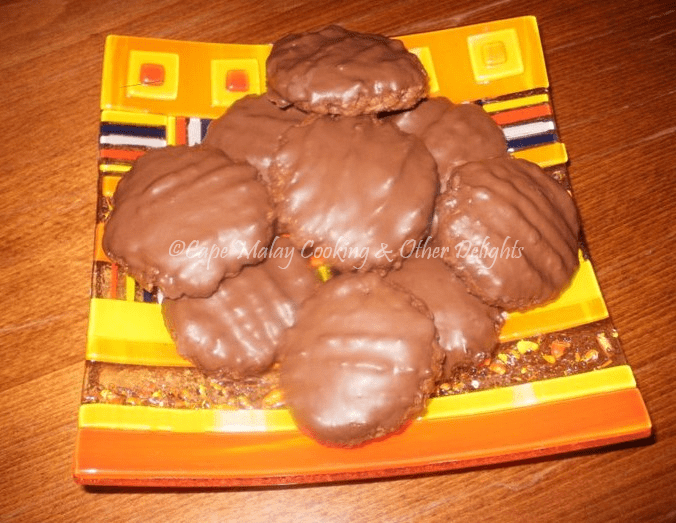
Chocolate Coconut Dreams
Ingredients:
2 cups cake flour (plain flour)
2 cups rolled oats
1 cup sugar
1 ¼ cup desiccated coconut
250g soft butter
5ml bicarbonate of soda
25ml boiling water
25ml cocoa powder
25ml golden syrup
2 large eggs, beaten
To complete: 200g cooking chocolate
Method:
Combine flour, oats, sugar & coconut in a large mixing bowl.
Rub in butter with finger tips to resemble fine crumbs.
Pour boiling water over bicarbonate of soda, stir in cocoa powder and golden syrup.
Beat eggs well and combine all ingredients. Mix well to form soft dough.
Divide into approx. 30 small balls. Place on a baking tray and press flat with a fork.
Bake in a preheated oven at 190 degrees Celsius for 10-12 minutes.
Cool on a cooling rack and dip the top of the biscuits in melted cooking chocolate.

Ingelegde Vis (Pickled Fish)

Ingelegde Vis / Pickled Fish
Ingredients:
1kg snoek or any firm fish cut into large slices
1 cup brown vinegar
1/2 cup water
1/4 cup cooking oil
1/4 cup lemon juice
1/4 cup sugar
3 large onions, sliced
1 lemon, sliced
1 tsp whole peppercorns
1 tsp salt
2 tsp ground coriander / koljana
1 tsp ground cumin / jeera
1/2 tsp turmeric /borrie
1/4 tsp dry ginger
1/4 tsp cayenne pepper
5 bay leavesMethod:
Season the fish chunks with salt and pepper, and quick-fry till opaque in a well-oiled pan. Remove and set aside.

Yellow Tail
Wipe the pan, and fry the sliced onions till they turn golden. Add the liquids and the spices, raise to boil, turn low and simmer for about five minutes. Turn off heat, allow to cool slightly.
Arrange the fish chunks and sliced lemon in a pyrex or glass dish, and pour sauce over. Cover, and refrigerate when completely cold. Leave the pickled fish to marinade for a day or two before eating. The flavour improves the longer its left before eating and will keep up to 2 weeks in the refrigerator. Serve with crusty buttered bread.

Fried Yellow Tail
Ingelegde Vis / Pickled Fish

Peaches & Cream Sponge Cake
Peaches & Cream Sponge Cake – Salwaa Smith – Cape Malay Cooking & Other Delights
Use the summer fruit which is in abundance now in South Africa, to decorate your cakes and bakes.

Peaches & Cream Sponge Cake
Ingredients:
1 cup castor sugar
4 extra large eggs
1 cup sunflower oil
2 tsp vanilla essence
1 1/2 cups cake flour
1 cup self raising flour
2 tsp baking powder
1/2 cup milk
300 ml fresh cream, whipped
Fresh or canned fruit of choice to decorate
Melted chocolate, optional
Roasted dessicated coconut for the sides, optional
#capemalaycooking
Method:
Preheat oven to 180 degrees Celsius. Grease 2 x 20cm baking tin with butter and dust the baking tins with flour or line the tins with greaseproof paper.
Cream eggs, sugar and oil until light and fluffy or until sugar has dissolved. Add vanilla essence. Add flour and baking powder and stir well. Stir in milk and mix to combine until the mixture is a smooth dropping consistency. Pour into prepared tins and bake for 20 – 25 minutes. To check if cake is done insert a skewer in the middle of the cake, if it comes out clean it is done. Allow to cool slightly, turn out into a cooling rack to cool down completely. Sandwich the cakes together with smooth apricot jam or lemon curd, chopped peaches and some of the whipped cream. Spread the remaining cream over the top and sides, decorate with fresh or canned fruit.
© Cape Malay Cooking & Other Delights
Click here for details of where to buy your Cape Malay & Other Delights Cookbook

Custard Tart
Custard Tart – Salwaa Smith – Cape Malay Cooking & Other Delights
Creamy custard tart baked in a shortbread tart case and topped with ground (fine) cinnamon or alternatively top with grated nutmeg. Delicious eaten warm or cold.

Custard Tart
Short bread base for milk tart
Ingredients:
1 large egg
125g soft butter/margarine
1/4 cup cooking oil
3/4 cup white sugar
1 tsp vanilla essence
2 cups self-raising flour
1 cup cake flour
l level teaspoon baking powder

Shortbread Tart Base
Using a large bowl mix the egg, sugar, softened butter and oil together until light and fluffy. Add vanilla essence, mix. Add the flour and baking powder and mix well to form a dough.
Line a 20cm pie dish with approximately half of the pastry. The pastry should be as thin as possible with no holes. Left over pastry can be frozen or you can use it to make herzoggies. Refrigerate whilst preparing the custard filling.
Filling:
3 cups of milk (semi-skimmed or full cream)
3 heaped Tbsp custard powder
3 extra large eggs
½ cup white sugar
1 tsp vanilla essence
½ tsp ground cinnamon
Extra ½ tsp ground cinnamon to sprinkle over the custard tart when baked.
Dissolve the custard powder in the milk. In a separate bowl whisk together the eggs and sugar until the sugar is dissolved. This should take about 5 minutes on high speed with an electric beater. Add the vanilla essence and cinnamon. Gradually add the milk and custard mixture to the egg mixture. Mix well to combine. Pour the liquid into the prepared pie crust. Bake at 180 degrees Celsius for 30 – 40 minutes. Leave to cool, sprinkle the extra ½ teaspoon of ground cinnamon over the top. Slice and enjoy. Makes 1 x 20cm round custard tart.

Custard Tart
© Cape Malay Cooking & Other Delights
Click here for details of where to purchase my Cape Malay & Other Delights Cookbook
 Cape Malay Cooking & Other Delights - Salwaa Smith
You must be logged in to post a comment.