Author Archives: Cape Malay Cooking & Other Delights
BANANA AND DATE MUFFINS
Makes 12
Ingredients:
2 overripe bananas, chopped
100g dates, chopped
½ cup vegetable oil
2 eggs
¾ cup brown sugar
1 teaspoon bicarbonate of soda
½ teaspoon cinnamon
1 teaspoon vanilla essence
1 ½ cups self raising flour
METHOD:
Mix all the wet ingredients together, add the dry ingredients until just combined.
Put into muffins trays, lined with muffins cases and bake at 150C for 20 minutes or until done.
Delicious!!

BANANA & DATE MUFFINS
STUFFED BUTTERNUT SQUASH
STUFFED BUTTERNUT SQUASH
Serves 4
Ingredients:
2 small butternut squashes
1 garlic clove, finely chopped
50g unsalted butter
Olive oil
75g walnuts, lightly toasted and very coarsely chopped
200g cheese of choice (blue cheese or feta cheese goes well with this), I used cheddar cheese
2 teaspoons chopped thyme (optional)
1 tablespoon runny honey
Salt and freshly ground black pepper
Method:
Make sure the outside of the squash is scrubbed clean. Cut the squash in half lengthways and scoop out the seeds and soft fibres. Put in a roasting dish, add the chopped garlic and a knob of butter to each cavity, brush with a little oil and season well. Place in an oven preheated to 190°C and bake for ¾-1 hour, until the flesh feels very tender when pierced with the tip of a knife.
Scoop the soft flesh and all the buttery, garlicky juices out into a bowl, leaving a 1cm thick layer of flesh still attached to the skin, so the squash holds its shape. Roughly mash the flesh. Keep back a few pieces of walnut and a little of the cheese, then fold the remaining walnuts and cheese into the soft squash, along with the thyme and some more salt and pepper.
Spoon the filling back into the empty squash halves and scatter on the reserved cheese and walnuts. Finish with the merest trickle of honey, return the squash to the oven and bake for 15 minutes, or until the cheese is bubbling. Serve with a crisp green salad, thinly sliced ciabatta for a great starter.

STUFFED BUTTERNUT SQUASH
DOUGHNUTS
DOUGHNUTS
Ingredients:
500gr plain flour
1/2 cup sugar
1 packet instant yeast
1 egg
1 dessert spoon butter
Pinch salt
1 teaspoon vanilla essence
Milk
750ml vegetable for frying
Method:
Dissolve sugar and butter in on cup boiling water. Cool down. Add beaten egg, salt, vanilla essence and enough milk to make 1/2 liter liquid.
Combine flour and yeast in a mixing bowl. Add liquid and mix to soft dough. (The dough will be very soft)
Set aside covered until rise. Divide dough into approx 25 small balls on a slightly oiled surface. Heat the oil in large saucepan. Once oil is hot gently pull each doughnut into an oblong shape and fry each side until browned. Drain on absorbent paper.
Sugar Syrup:
Boil together, 500ml water and 250ml sugar until sugar has dissolved and syrup is slightly sticky and thickened. Dip doughnuts in syrup and sprinkle with desiccated coconut.
Variation:
Dip the doughnuts whilst lukewarm in a plate of white sugar
Dip cooled doughnuts in cold sugar syrup, make a slit length wise in doughnut, fill with strawberry jam and whipped fresh cream.

TRADITIONAL DOUGHNUTS
BREAD ROLLS
Rolls
Makes about 10, depending on the size.
Ingredients:
500g plain flour
½ teaspoon salt
1 packet instant yeast
2 tablespoons oil
2 tablespoons plain yoghurt
25g sugar
1 egg
½ – ¾ cup warm milk
Method:
In a large bowl add the flour, salt, sugar and yeast.
In a separate bowl mix the egg, oil and yoghurt. Add to the flour.
Add the milk and mix thoroughly.
Knead the dough until smooth and the dough no longer stick to your hands.
Cover the bowl with plastic and leave to rise in a warm place until double in size.
Knock the dough down to let the air come out.
Divide the dough into 10 and form into shapes.
Place in a baking tray dusted with flour. Leave to rise for 10 minutes.
Brush with beaten egg, sprinkle with sesame seeds (optional).
Bake in a preheated oven at 190C until light brown approx 25 – 30 minutes.
Tear & Share
I’ve used my basic rolls recipe for this, use small pieces of dough roll into a ball between your palms. Arrange in a round baking tray couple of centimetres apart to allow rising. Bake as usual and enjoy!

Plaited Rolls
Again I’ve used the basic recipe. Divide the dough into three equal pieces and roll to form three even ‘sausage’ shapes. Plait the three dough ‘sausages’ together to form a large loaf and place onto a lightly floured baking tray.

ORANGE CAKE
This delicious cake is rich and full of flavours. Perfect snack or afternoon treat!

Orange Cake, a deliciously moist cake!
Ingredients
Serves: 12
250g cake (plain) flour
3 teaspoons baking powder
200g caster sugar
125ml milk
125ml orange juice
125ml vegetable oil
3 eggs, beaten
1 ½ teaspoons grated orange zest
Orange butter icing:
6 tablespoons butter, softened
250g icing sugar
2 tablespoons orange juice
1 teaspoon vanilla extract
1 teaspoon grated orange zest
Method:
Preheat oven to 180C. Grease and flour two 20cm round cake tins.
In a measuring jug, combine milk, 125ml orange juice, oil, beaten eggs and
1½ teaspoons orange zest. Set aside.
Sift flour and baking powder into a large bowl. Mix in sugar. Make a well in the centre and pour in the milk mixture. Stir until thoroughly combined.
Divide cake mixture between the two prepared tins. Bake in the preheated oven for 35 minutes, or until a skewer inserted into the centre comes out clean. Allow to cool.
To make Orange Butter Icing:
Cream butter until smooth. Gradually beat in icing sugar. Beat until light and fluffy. Beat in 2 tablespoons orange juice to bring to spreading consistency. Stir in vanilla and 1 teaspoon orange zest. Spread over cooled cakes.
ENJOY!!

Orange cakes are especially delicious in winter when citrus is in season
COOK’s TIP FOR BAKING A PERFECT CAKE:
When making a cake it is important to follow the recipe exactly. If you try to skip a step you may have less than desirable results. Skip the sifting step and your flour will be heavier than it should, creating a heavy, dry cake. Over-mix and your cake will be tough and chewy, more like a good bread.
First, use the right ingredients and measure carefully.
Beat the liquid ingredients well before combining with the dry ingredients. Once the dry ingredients are added, the cake should be stirred gently, unless the directions tell you otherwise. If your cake is course and dry, or has tunnels, you have probably over-mixed.
Preheat the oven as directed. Starting in a cold oven, or too hot an oven will affect the rising and browning of the cake. A cake started in a cool oven will not allow the cake to rise sufficiently before the crust forms and the cake may fall. Too hot an oven may cause a crack to develop, and the crust to harden and overbrown. The cake should be placed in the center of the oven for best heat distribution. Be aware of your oven, if there are hot spots in your oven you may need to adjust.
The cake is done when it is lightly browned and it springs back when lightly pressed with the fingertip in the center or when a toothpick inserted into the center comes out clean and dry. The cake will have begun to shrink away from the sides of the pan.
Ensure your ingredients are room temperature before starting your cake.
CROISSANTS
Croissants are made of a leavened variant of puff pastry. The yeast dough is layered with butter, rolled and folded several times in succession, then rolled into a sheet, a technique called laminating.
Croissant pastry can also be wrapped around any praline, almond paste or chocolate before it is baked (in the last case, it becomes like pain au chocolat, which has a different, non-crescent, shape), or sliced to admit sweet or savoury fillings. In France and Spain, croissants are generally sold without filling and eaten without added butter, but sometimes with almond filling
CROISSANTS
Flaky and flavourful, serves 10
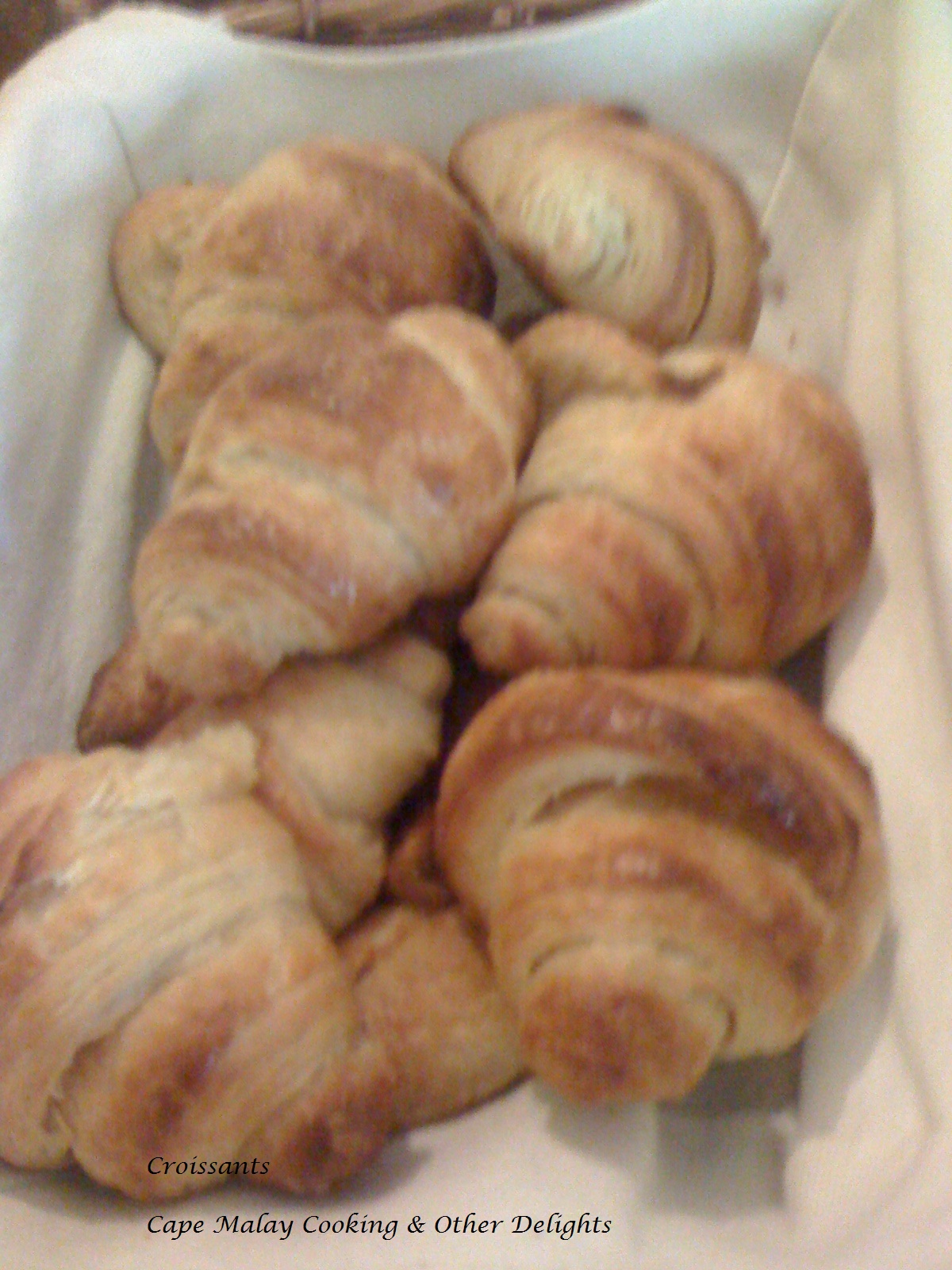
Enjoy with sweet or savoury fillings!!
| Ingredients: | |
| 500 g flour
15g instant yeast 90 g sugar 15 g salt 300 ml warm milk 340 g butter , room temperature 1 egg , beaten with 2 Tbsp water some extra flour |
Method:
Step 1: Begin the dough
Put the flour into a large mixing bowl. Add the salt, sugar, milk and yeast. Mix and knead the dough until it has a smooth elastic consistency, about 15 – 20 minutes. (I find it is easier to knead the dough out of the bowl directly on the work surface) Dust the dough and a large bowl with flour. Transfer it into a bowl. Cover it with a towel and let it rise until it doubles in size. This should roughly, take 1.5 to 2 hours.
Step 2: Prepare the butter
Put a sheet of cling film onto your working surface. Place the butter on top and cover it with a second sheet of cling film. Flatten it with your hands, roll it into a rectangle of about 20 X 25 cm with your rolling pin and place it into the fridge to chill.
Step 3: Roll out dough
After the dough has doubled in size, sprinkle it with a little bit of flour. Punch out the air with your knuckles and place it onto a floured work surface. Dust the dough with flour and roll it out into a large rectangle that is big enough to hold the sheet of chilled butter. Move the dough around in the flour. You may have to dust the table again, if you need to.
Step 4: Fold in butter
Unwrap the chilled butter and place it onto the upper part of dough. Fold the dough around the butter to enclose it completely. Lift the dough and sprinkle the table with flour. Turn the dough around and roll it into another long rectangle. Fold the dough into thirds, brushing off the excess flour as you go. This completes the first turn. Now wrap it in cling film and place it into the fridge for a minimum of 25 to 30 minutes.
Step 5: Turn the dough
At the end of the 30 minutes sprinkle your working surface with flour. Unwrap the dough and place it onto the work surface. Make sure that the dough has the seam vertically placed. Dust it with a sprinkling of flour and roll it out into another rectangle. Fold, brush and wrap, exactly as before. This now completes the second turn.
Step 6: Chill and turn again
Place it back into the fridge for another 30 minutes. Once removed, roll and fold for the third and final turn. Make sure that the dough is well wrapped before placing into the fridge once more to chill overnight.
Step 7: Shape the croissants
One chilled, cut the unwrapped dough into half, on a floured surface. Dust the dough with some flour and roll one half of the dough into a rectangle. Reflour the surface when necessary and continue to roll until the dough is roughly less than half a centimetre thick. Turn the rectangle around. Flour the surface and trim the edges of the dough neatly. Cut it into triangle shapes. Take the bottom of the triangle at its widest part and using your hands, tightly roll it up into a croissant shape. You can freeze the other half of the dough for use another time, or repeat the process and make more croissants.
Step 8: Allow to rise
Place the croissants onto a prelined baking tray. Cover them with a clean plastic bag and leave to double in size.
Step 9: Preheat the oven
Set the oven to 180ºC.
Step 10: Bake
Once the croissants have risen remove the plastic bag. Very gently brush them all over with the egg wash. Place them into the centre of the oven. Bake them for roughly 20 – 25 minutes. When they are a deep golden brown remove them from the oven.
BANANA LOAF
Banana Loaf
Ingredients:
125g butter
Extra butter for greasing the tins
1 cup sugar
3 eggs
1 cup milk
1 teaspoon bicarbonate of soda
500g selfraising flour
4 bananas, mashed
Method:
Preheat oven to 180C. Grease 1 large loaf tin or 2 small loaf tins with the extra butter.
In a mixing bowl cream together butter, sugar and eggs.
Mix in mashed bananas. Add flour, bicarb and milk and mix to a thick batter. Pour into the prepared tins. Bake in preheated oven for 30 – 40 minutes. To test if the cake is done insert a skewer in the middle of the cake, if it comes out dry the cake is done.

BANANA LOAF
PANCAKES
Basic pancake mixture
Ingredients:
110g plain flour, sifted
Pinch of salt
2 eggs
200ml milk mixed with 75ml water
50g butter
Preparation method
1. Sift the flour and salt into a large mixing bowl with a sieve held high above the bowl so the flour gets an airing. Now make a well in the centre of the flour and break the eggs into it. Then begin whisking the eggs – any sort of whisk or even a fork will do – incorporating any bits of flour from around the edge of the bowl as you do so.
2. Next gradually add small quantities of the milk and water mixture, still whisking (don’t worry about any lumps as they will eventually disappear as you whisk). When all the liquid has been added, use a rubber spatula to scrape any elusive bits of flour from around the edge into the centre, then whisk once more until the batter is smooth, with the consistency of thin cream. Now melt the 50g of butter in a pan. Spoon 2 tbsp of it into the batter and whisk it in, then pour the rest into a bowl and use it to lubricate the pan, using a wodge of kitchen paper to smear it round before you make each pancake.
3. Now get the pan really hot, then turn the heat down to medium and, to start with, do a test pancake to see if you’re using the correct amount of batter. I find 2 tbsp is about right for an 18cm pan. It’s also helpful if you spoon the batter into a ladle so it can be poured into the hot pan in one go. As soon as the batter hits the hot pan, tip it around from side to side to get the base evenly coated with batter. It should take only half a minute or so to cook; you can lift the edge with a palette knife to see if it’s tinged gold as it should be. Flip the pancake over with a pan slice or palette knife – the other side will need a few seconds only – then simply slide it out of the pan onto a plate.
4. Stack the pancakes as you make them between sheets of greaseproof paper on a plate fitted over simmering water, to keep them warm while you make the rest.
Fill with coconut, lemon juice, or instant pudding with banana slices,etc

PANCAKES FILLED WITH CARAMEL CONDENSED MILK & BANANA SLICES
CHOCOLATE CAKE
CHOCOLATE CAKE
Quick and economical to make!!
These ingredients makes a 20cm round cake. For a larger or square cake double the amounts and adjust your baking time accordingly.
Ingredients:
3 eggs separated (use the yolk)
3/4 cup sugar
1/2 cup water
1/2 cup oil
Mix the above ingredients well.
ADD
3 teaspoons baking powder
1/4 cup cocoa
1 teaspoon cinnamon
1 cup flour
Whip egg whites until stiff. Fold into cake mixture. Divide into 2 well greased round (20cm) baking tins and bake in a preheated oven at 180C for approx 15-20 minutes. Decorate with cream, butter cream, icing sugar….


CARROT CAKE
CARROT CAKE
Ingredients:
300g cake flour
2 teaspoons ground cinnamon
1 teaspoon baking powder
½ teaspoon bicarbonate of soda
200g soft brown sugar
4 eggs
250ml oil
1 orange, zested
1 lemon, zested
200g carrots, finely grated
150g walnuts, chopped
227g tin pineapple pieces, well drained and chopped (optional)
FOR THE CREAM CHEESE FROSTING
125g unsalted butter at room temperature
50g icing sugar
250g cream cheese
Method:
Heat the oven to 170C/fan. Line a 20cm, 10cm deep cake tin. Sift the flour, cinnamon, baking powder and bicarbonate of soda together and stir in the sugar. Beat the eggs with the oil and citrus zests. Stir in the carrots and fold everything into the flour mixture. Fold in the walnuts and pineapple if using. Spoon the mixture into the tin and bake for 45 minutes or until a skewer comes out clean. Cool.
For the frosting, beat the butter and icing sugar together until soft and then beat in the cream cheese. Chill the mixture until it’s thick but spreadable. Spread a thick layer on top of the cake, making sure the side of the icing is flat and continues upwards from the side of the cake. Decorate with walnuts (optional)
 Cape Malay Cooking & Other Delights - Salwaa Smith
You must be logged in to post a comment.